




What flowers are good for an indoor garden? The easiest answer is African violet, peace lily, moth orchid, kalanchoe and Christmas cactus, because they flower well in normal rooms and forgive small mistakes.
Those five are only the start. Below you will find 14 flowering plants, a season-by-season bloom guide, clear steps for pots, winter and low light, and a fix-it table for common problems. If you want a short start, the first 10 indoor flowering plants on the list are the easiest, and the last four suit brighter, warmer homes.
Why Indoor Blooms Are Worth Growing
A pot of flowers changes a room faster than paint or new cushions. Color on a shelf or windowsill lifts your mood, especially on grey days, and it gives you something living to look after.
Indoor flowers also last longer than a bouquet. A cut bunch fades in a week, while one good plant can flower for months and then come back next season. For the same money, a flowering houseplant is simply better value.
Check Your Home Before Buying
Five minutes of checking now saves you from buying a plant that will never bloom.
Measure the Light
Hold your hand about a foot above the spot at midday. A sharp, dark shadow means bright light. A soft shadow means medium light, and a faint one means low light. Most flowering plants need bright or medium light, so note which spots in your home pass this test.
Test the Temperature
Most indoor bloomers are happy between 18 and 24°C (65 to 75°F). A cheap thermometer on your shelf shows the real number, and a check at night shows the lowest one.
Map the Space
List your free spots before you shop: a shelf, a desk, a hanging hook and a floor corner. Write the light score from the test above beside each one, and note how much height it has. With that short list, every plant you buy already has a place waiting.
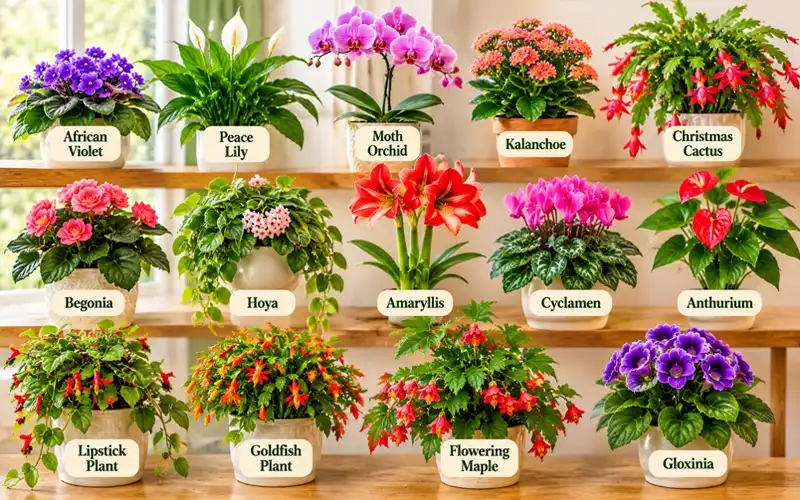
14 Indoor Flowering Plants Worth Growing
Each plant below has a short note on how it looks, plus the light and water it needs. Bloom months are in the season guide further down, so you will not read them twice.
African Violet
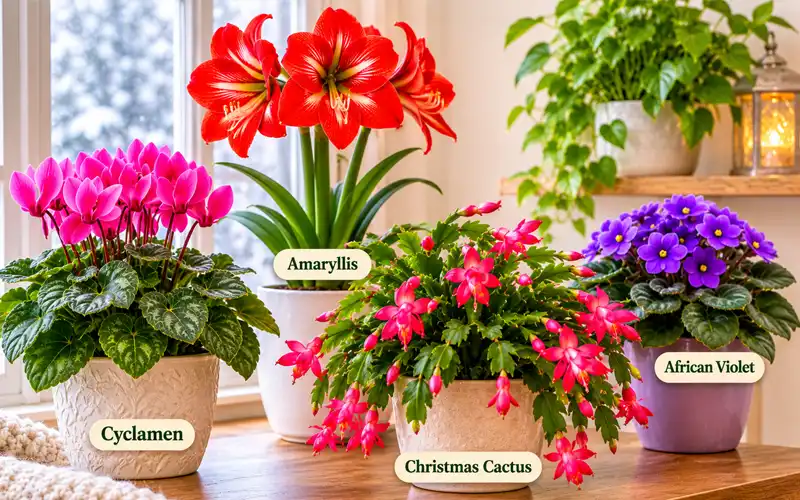
Small, velvety and almost always in flower, this is the classic windowsill bloomer. Its purple, pink or white flowers appear in waves, and the plant stays compact enough for a shelf.
- Light: Bright, filtered light.
- Water: At the base, not on the leaves, using room-temperature water.
Peace Lily
Glossy green leaves and white, hood-shaped blooms make this plant look elegant even when it is not flowering. It droops clearly when thirsty, which makes it easy to read.
- Light: Medium to low light.
- Water: When the leaves just begin to sag.
Moth Orchid
Orchids look fancy, but moth orchids are surprisingly forgiving. One flower spike can carry blooms for two to three months, and the plant often flowers again the following year.
- Light: Bright, indirect light, such as an east window.
- Water: About once a week, letting the water drain fully from the bark.
Kalanchoe
A tough succulent covered in tiny flower clusters in red, orange, pink or yellow. It stores water in its leaves, so it forgives forgetful owners, and it is cheap and easy to find in shops.
- Light: Bright light, including a little direct sun.
- Water: Only when the soil is completely dry.
Christmas Cactus
Despite the name, this plant has no spines, only flat, jointed stems that arch over the pot and end in bright, tube-shaped flowers. It can live for decades, and cooler, longer nights help it set buds.
- Light: Bright, indirect light.
- Water: Lightly, once the top of the soil dries.
Begonia
Begonias give you two things at once: colorful flowers and attractive leaves, some with silver spots or red undersides. Wax and cane begonias are the easiest types to grow in pots.
- Light: Bright, but away from harsh midday sun.
- Water: When the top of the soil dries; never let it sit wet.
Hoya
Hoya, or wax plant, grows long vines and carries round clusters of small, star-shaped, sweet-smelling flowers. It is slow, patient and long-lived, so it rewards people who leave it alone. Do not remove the old flower stalks, because new blooms grow from the same spots each year.
- Light: Bright light with a little gentle sun.
- Water: Sparingly, after the soil has dried well.
Amaryllis
Amaryllis grows from a big bulb and sends up a thick stem topped with giant trumpet flowers about 6 to 8 weeks after planting. Few plants give so much drama for so little work, and a single bulb often makes two or three stems.
- Light: Bright light, with a stake to hold up tall stems.
- Water: Lightly at first, then a little more once the stem grows.
Cyclamen
This plant is a winter treat, with swept-back petals in pink, red or white above heart-shaped, patterned leaves. It prefers a cool room, which makes it a good match for homes that are not heated all day.
- Light: Bright, but cool.
- Water: From the saucer, so the crown stays dry.
Anthurium
Also called the flamingo flower, anthurium has glossy, heart-shaped blooms in red, pink or white that look as if they are made of wax. Each flower lasts for weeks, and the plant keeps making new ones.
- Light: Bright, filtered light.
- Water: Moderately, with a good drain.
Lipstick Plant
Trailing vines carry glossy leaves, and the red, tube-shaped buds peek out of dark cups like a tube of lipstick. Hang it near a bright window and keep it warm and slightly humid.
- Light: Bright, filtered light.
- Water: Lightly, when the top inch of soil is dry.
Goldfish Plant
Its bright orange flowers look like tiny goldfish leaping from the stems, which makes it a favorite for hanging baskets. It likes warmth and a humid room.
- Light: Bright, filtered light.
- Water: Evenly moist, never soggy.
Flowering Maple
This fast grower has maple-shaped leaves and hanging, bell-like flowers in orange, red or yellow. It can reach shrub size and likes regular feeding.
- Light: Strong light, with some direct sun.
- Water: When the top of the soil dries.
Gloxinia
Velvety, bell-shaped flowers in deep purple, red or white sit above broad, soft leaves. It grows from a tuber and stays small. When the flowers fade in autumn, stop watering and let the tuber rest in a cool, dry spot until new shoots appear.
- Light: Bright, filtered light.
- Water: Lightly and evenly, using lukewarm water.
Find Your Best Match in 60 Seconds
Not sure where to start? Match your situation to a plant.
- Dim room: peace lily, or any pick with a grow light.
- First plant ever: kalanchoe or hoya.
- Tiny shelf: African violet or gloxinia.
- Cool room: cyclamen or Christmas cactus.
- Hanging spot: lipstick plant or goldfish plant.
- Big wow: amaryllis or flowering maple.
- Gift: moth orchid or anthurium.
Indoor Flowering Plants That Bloom All Year
Near Nonstop Bloomers
No plant flowers every single day, but African violet, lipstick plant and flowering maple come closest. In a steady, bright spot, each flowers in flushes across most of the year. Every other plant on this list follows a season, which the guide below shows.
Season by Season Bloom Guide
Pick two or three plants from different rows, and something will always be in flower.
| Season | Plants in bloom |
| Spring | Moth orchid, kalanchoe, peace lily, begonia, anthurium, goldfish plant |
| Summer | Hoya, gloxinia, begonia, anthurium, goldfish plant, peace lily |
| Autumn | Christmas cactus, begonia, anthurium, cyclamen, peace lily |
| Winter | Amaryllis, moth orchid, Christmas cactus, cyclamen, kalanchoe |
| All year | African violet, lipstick plant, flowering maple |
Best Flowers for an Indoor Garden in Pots
If you are asking what flowers are good for an indoor garden in pots, choose compact plants with shallow roots, because they stay happy in small containers for years.
Match Plants to Pot Size
Compact plants live happily in pots under 15 cm (6 in). Trailing plants suit small hanging pots, and tall bulbs need a heavy base, because their tall flowers can tip a light pot over.
Choose the Right Pot
Pick a pot with a drainage hole, because roots rot without an exit for extra water. Terracotta dries quickly and suits kalanchoe and hoya, while glazed or plastic pots hold moisture longer and suit African violets and begonias.
Mix Good Soil
Never use garden soil indoors, as it packs down and brings pests. Use a light potting mix for most plants, and add one part perlite to every three parts of mix for better drainage. African violets and orchids do best in their own special mixes.
Repot Gently
Repot only when roots push out of the drainage holes, and wait until flowering has finished.
- Water the plant a day before, so the roots are easier to lift.
- Choose a pot only one size larger, since extra space makes the plant grow leaves instead of flowers.
- Loosen the root ball lightly with your fingers.
- Set the plant at the same depth as before and fill in fresh mix.
- Water lightly and keep it out of strong sun for a few days.
Flowers That Can Grow Indoors Without Sunlight
Flowers cannot bloom in a completely dark room, but without sunlight often just means without direct sun, and that is easy to solve. If you want flowers that can grow indoors without sunlight, the secret is a lamp.
Understand the Limits
Zero light means a windowless room, where plants may survive for a while but will not flower. Flowers need more energy than leaves, so they need a real light source of some kind, even if it is only a lamp.
Add a Grow Light
A full-spectrum LED bulb or strip works well and fits a normal lamp. Place it 15 to 30 cm (6 to 12 in) above the plant, a little closer for small plants like African violets. Cool LEDs do not burn leaves, so they are safe to use at close range.
Set a Daily Schedule
Plants need about 12 to 14 hours of light a day, and they also need a dark rest at night. A plug-in timer does this for you. If the leaves look bleached, move the lamp back or shorten the time.
Pick Low-Light Helpers
Peace lily copes with dim rooms on its own. African violet and begonia flower in them only with a lamp from the steps above.
Winter Flower Ideas for an Indoor Garden
If you ask what flowers are good for an indoor garden in winter, cyclamen and amaryllis lead the list, because they bloom when the days are shortest. Cold weather also brings new problems, so these four steps keep everything healthy.
Protect From Drafts
Cold glass and gaps around windows chill leaves at night. Move plants a hand’s width away from the glass, and keep them clear of heaters and doors that open often.
Raise the Humidity
Heated air is very dry and can crisp leaf edges. Group plants together, set pots on a tray of wet pebbles with the pot base above the water, or run a small humidifier nearby. A level of 40 to 50 percent suits most flowering plants.
Water Less Often
Plants grow slowly in short, dim days, so they use less water. Check the soil with your finger before each watering, and expect to water about half as often as in summer.
Ease Off Fertilizer
Pause fertilizer for most plants until spring. Plants that are flowering now, such as cyclamen and Christmas cactus, can have quarter-strength feed every four to six weeks.
Quick List of Indoor Flowering Plants With Pictures
Use this table as a shopping list. It shows how hard each plant is to grow and whether it is safe around pets, based on ASPCA listings.
| Plant | Difficulty | Pet-safe |
| African violet | Medium | Safe |
| Peace lily | Easy | Toxic |
| Moth orchid | Medium | Safe |
| Kalanchoe | Easy | Toxic |
| Christmas cactus | Easy | Safe |
| Begonia | Easy | Toxic |
| Hoya | Easy | Safe |
| Amaryllis | Easy | Toxic |
| Cyclamen | Medium | Toxic |
| Anthurium | Medium | Toxic |
| Lipstick plant | Medium | Check ASPCA |
| Goldfish plant | Medium | Check ASPCA |
| Flowering maple | Medium | Check ASPCA |
| Gloxinia | Medium | Check ASPCA |
Plant Care Habits That Make Flowers Last
When you search what flowers are good for an indoor garden plants, you get long lists. What most lists skip is daily care, so here are four short habits that keep the flowers coming.
Deadhead Spent Flowers
Pinch off faded blooms at the base with your fingertips or clean scissors, but not on hoya. The plant then stops spending energy on seeds and makes new buds instead. Petals left on the soil can also grow mould, so tidy them up.
Trim for Fuller Growth
After a flush of flowers, cut leggy stems back by about a third, just above a leaf. This works well for begonia, flowering maple and lipstick plant, and it creates branches that carry more blooms.
Feed on a Schedule
From spring to autumn, feed every two to four weeks with a bloom-boosting fertilizer. Full-strength feed can burn roots, so mix it at half strength.
Spot Pests Early
Once a week, look under the leaves for tiny white fluff, sticky patches or fine webbing. Most problems can be wiped away with a damp cloth or a mild soap and water spray. Catching them early takes seconds, while a big infestation takes weeks.
Rotate Weekly
Give the pot a quarter turn each week so every side of the plant gets light. Stop turning it as soon as buds appear.
Fix Common Problems Fast
Find the symptom in the first column, then apply the fix.
| Problem | Likely cause | Fix |
| Buds fall before opening | A move, a cold draft or dry air | Keep one steady spot, clear of vents and cold glass |
| Yellow leaves, soft stems | Soggy soil | Empty the saucer after 20 minutes, and let the top two knuckles of soil dry |
| Drooping, with shrunken, dry soil | Too little water | Soak the pot from below for 15 minutes, then let it drain |
| Tall, pale stems, no flowers | Too little light | Move to a brighter spot or add a lamp |
| Brown, crispy patches | Hot afternoon sun through glass | Add a sheer curtain or step back a foot or two |
| Flowers fade within days | Warm, dry room | Move to a cooler spot away from heaters |
Pet and Child Safety Notes
The table above marks each plant as safe, toxic or worth checking. Toxic plants can cause mouth irritation, drooling or an upset stomach if chewed, and amaryllis bulbs and cyclamen tubers are the most harmful parts.
Place risky plants on high shelves or in hanging pots, and look up any plant marked Check ASPCA on the ASPCA toxic and non-toxic plant list before you buy. If a pet or small child chews a plant, call your vet or a poison helpline right away.
Frequently asked questions
Which Indoor Flower Blooms Longest?
Plants that make new buds in waves give the longest total show, and the All year row in the season guide lists them.
Can I Grow Flowers From Seed Indoors?
Yes, with strong light. Dwarf marigolds and sweet alyssum can flower in pots on a very bright sill or under a grow light. Most garden annuals, however, prefer to move outside later.
Should I Buy Plants With Buds?
Choose a plant with many closed buds and just a few open flowers. It will last longer at home than one in full bloom, which may already be near the end.
May Indoor Flowers Spend Summer Outside?
Yes, in a shady, sheltered spot once nights stay above 12°C (54°F). Bring them back inside before nights turn colder, and expect a few leaves to drop while they adjust.
Is It Safe to Buy Plants Online?
Yes, if the seller has recent reviews and a delivery guarantee. Unpack the plant straight away, water lightly, and keep it apart from your other plants for two weeks.
Does Tap Water Harm Indoor Flowers?
In most homes, tap water is fine. Let it stand in an open jug overnight so some of the chlorine can escape. If leaf tips turn brown or a white crust forms on the soil, switch to filtered or rainwater.
Will Any of These Flowers Make a Room Smell Nice?
Most plants on this list have little scent. Hoya is the best choice, because its sweet flower clusters often smell stronger in the evening, and some moth orchid varieties are lightly fragrant.
Final Thoughts
You do not need a big space or green fingers to enjoy flowers at home. Start with two or three plants that match your light, such as one easy pick and one pet-safe pick. Once those settle in and bloom, adding more becomes the fun part.