



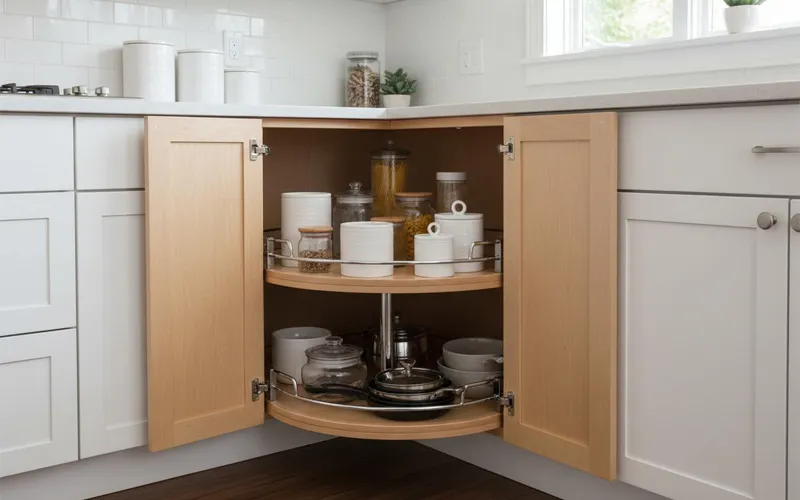
Corner kitchen cabinets can hold a surprising amount of kitchenware, but they are not always easy to use. You might push a mixing bowl toward the back and forget about it, struggle to pull out a pan, or find yourself moving several containers just to reach one small item. These little frustrations can make cooking less enjoyable, especially when the cabinet is already full.
Learning how to organize a corner kitchen cabinet can make a real difference without requiring a complete kitchen makeover. The trick is to understand what your cabinet can comfortably hold and arrange everything around your daily routine. A rotating shelf may work well in one kitchen, while another may benefit more from sliding baskets, simple dividers, or a few well-placed containers. You do not need to buy every storage product you see. Start with what you have, identify the problem areas, and make changes that genuinely help.
Understand Your Corner Cabinet Before You Begin
Before rearranging anything, take a good look at the cabinet itself. Some corner cabinets have angled doors and wide shelves, while others have a narrow opening that leads into a much deeper space. Upper cabinets bring their own challenges because the back shelves may be difficult to reach. Knowing which type you have will help you avoid buying organizers that do not fit.
Empty the cabinet and place everything on your kitchen counter. Wipe the shelves, remove crumbs, and let the interior dry before putting anything back. This is also a good opportunity to get rid of chipped dishes, broken utensils, duplicate tools, and food containers that have lost their lids.
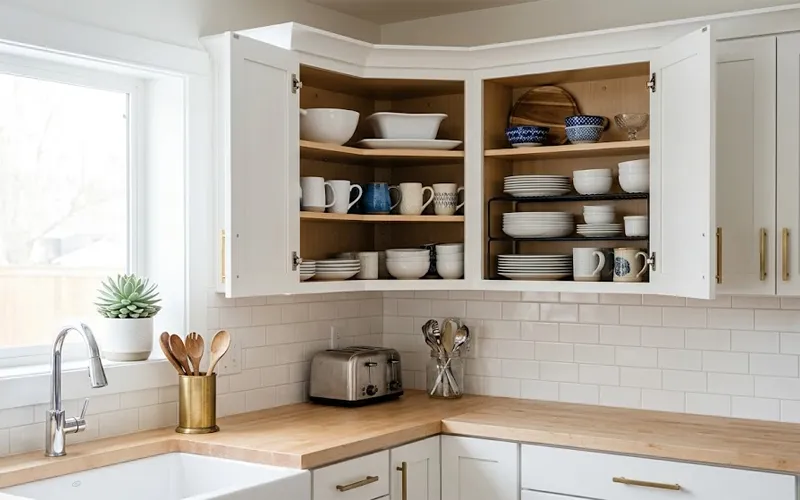
Next, measure the cabinet’s width, depth, shelf height, and door opening. Pay attention to hinges, pipes, and anything else that could get in the way of an organizer. A product may fit inside the cabinet but still fail to pass through the opening or prevent the door from closing properly.
Once you know what space you have, group your remaining items by purpose. Keep cookware together, separate baking supplies, and collect small accessories in one place. This simple step makes it much easier to decide where everything belongs.
Arrange Everyday Items Around Your Cooking Routine
When deciding how to organize a corner kitchen cabinet, think about the things you reach for most often. Your storage arrangement should make everyday cooking easier, not force you to move half the cabinet whenever you need a bowl or pan.
For example, if you bake regularly, keep measuring cups, mixing bowls, and baking accessories in a convenient area. If you prepare vegetables frequently, a colander and suitable food preparation tools might deserve a spot near your usual work surface. Items you use only during holidays or special occasions can occupy less accessible shelves.
Try to keep similar items together rather than placing them wherever there happens to be room. Pots can be nested when their shapes allow it, while small utensils can sit in a sturdy container. Keep stacks low enough that you can remove individual items without making everything above them wobble.
There is no need to fill every empty corner. Leaving a little breathing room makes it easier to see what you own and return items after use. A cabinet that is easy to use will usually stay organized longer than one packed tightly from front to back.
Upper Corner Kitchen Cabinet Organization Ideas
Upper corner cabinets often have awkward angles, deep shelves, or limited openings. The best arrangement depends on the cabinet’s height and how comfortably you can reach its contents.
One of the most useful upper corner kitchen cabinet organization ideas is to arrange dishes according to size and frequency of use. Keep everyday cups, small bowls, and plates on a shelf you can reach comfortably. Less frequently used serving dishes can go farther back, provided they remain easy and safe to retrieve.
A compact shelf riser can create another level for saucers, small bowls, or cups when there is enough vertical clearance. Choose a stable riser that fits the shelf and can support the combined weight of its contents. Avoid stacking dishes so high that removing one becomes awkward.
If you are wondering what to put in upper corner kitchen cabinet storage, lightweight mugs, tea accessories, small plates, and occasional serving pieces are usually sensible choices. You can also use the cabinet for lightweight baking supplies or spare tableware if the location suits your kitchen routine.
Heavy appliances, large cast-iron pans, and bulky containers filled with food are better kept in lower storage areas. They can be difficult to lift from an overhead shelf, especially when positioned near the back. If the cabinet is particularly high, reserve it for things you rarely need and use a stable step stool rather than stretching or climbing on a chair.
Deep Corner Kitchen Cabinet Organizer Solutions
Deep corner cabinets can accommodate large pots, mixing bowls, food containers, and other bulky supplies. The difficulty is reaching the items at the back without disturbing everything in front of them. Choosing the right deep corner kitchen cabinet organizer can make that space much more practical.
Pull-out shelves are worth considering if your cabinet’s dimensions and construction allow them. They slide toward the opening, making stored items easier to see and retrieve. This can be especially helpful for cookware or containers that would otherwise sit behind larger objects.
If installing a pull-out system is not an option, handled baskets offer a simpler alternative. Use one for baking supplies and another for food storage containers or small kitchen tools. You can pull out an entire category when needed instead of searching through loose items.
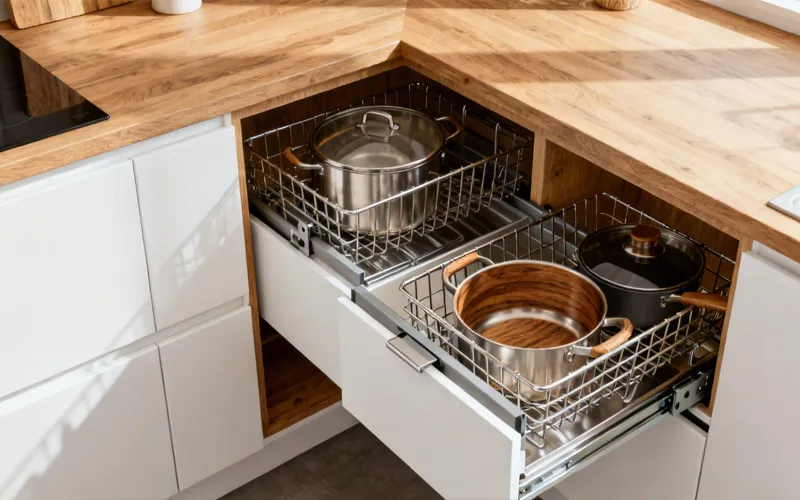
For fixed shelves, keep frequently used pieces near the opening and reserve the deeper area for things you use occasionally. A vertical lid rack can prevent pot lids from becoming buried, while a suitable divider can keep baking trays together without forcing you to lift a heavy stack.
Before choosing any organizer, check its dimensions and weight capacity. A sliding mechanism needs enough clearance to operate, and its shelves must be strong enough for the items you intend to store. If a product does not fit your cabinet properly, a few well-chosen baskets may be the better solution.
Choosing the Right Blind Corner Cabinet Organizer
A blind corner cabinet is different from a standard corner unit because part of its interior extends behind an adjoining cabinet. The opening may be relatively narrow even though the hidden space is quite large. This is why items often become difficult to see or retrieve.
A suitable blind corner cabinet organizer can bring some of that hidden storage forward. Depending on the design, it may use sliding trays, linked shelves, or pull-out baskets that move toward the opening. These systems can work well for cookware, food containers, and other supplies that would otherwise remain out of sight.
Before buying one, measure the usable opening rather than relying only on the cabinet’s overall dimensions. Check the depth, hinge position, available clearance, installation requirements, and weight limits. Some organizers are designed for specific cabinet layouts, so a product that works in one kitchen may not suit another.
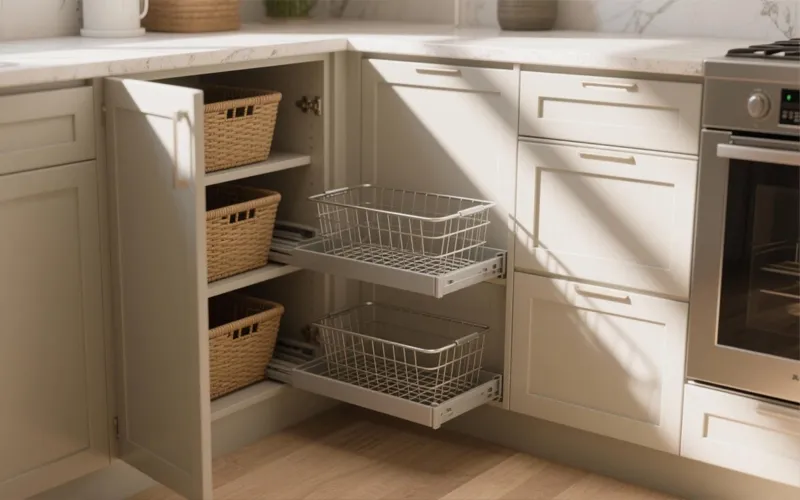
You can also improve a blind corner cabinet without installing a complicated mechanism. Place smaller groups of items in lightweight, easy-to-handle bins and keep the most frequently used supplies near the opening. Reserve the hidden section for occasional-use items, such as seasonal baking equipment or extra serving pieces.
The right choice comes down to how often you use the hidden space and how much you want to spend. If the cabinet is used every day, a pull-out system may be worthwhile. If you only store occasional items there, a simpler arrangement may be all you need.
How to Organize a Corner Cabinet Without a Lazy Susan
A Lazy Susan is not the best option for every corner cabinet. Circular trays can leave awkward gaps when you need to store rectangular baking dishes, flat trays, or large cookware. If your cabinet has fixed shelves or an opening that does not suit a rotating mechanism, there are other ways to make the space easier to use.
One option is to install sliding shelves or drawers, provided the cabinet has enough room for them. These bring stored items closer to the opening and reduce the need to reach into the back. They are particularly useful for food containers, smaller appliances, and cookware that is awkward to lift.
Another option is to use vertical racks for cutting boards, baking sheets, or flat serving dishes. This keeps them separate and allows you to remove one without lifting the entire stack. Small shelf dividers can also help separate dishes or cookware, while compact risers provide an extra level for suitable items.
Storage bins are useful for loose accessories, packets, and lids. Choose sizes that fit the cabinet without blocking the hinges or door. Keep each container dedicated to a particular category so you can find what you need quickly.
If you have been searching for how to organize a corner cabinet without a Lazy Susan, start by identifying what makes your current cabinet inconvenient. You may need better visibility, more room for rectangular items, or an easier way to reach the back. Solve that particular problem instead of buying an organizer simply because it is popular.
How to Organize a Lazy Susan Cabinet
A Lazy Susan can be a convenient choice for a corner cabinet because the rotating tray brings items around to you. However, it works best when its contents are arranged carefully. If everything is placed randomly, small containers can become difficult to identify and bottles may move around as the tray turns.
Start by removing the contents and cleaning the shelves. Check that the rotating mechanism moves smoothly and that nothing is obstructing it. Then group the items according to their purpose. A cabinet near the cooking area might hold oils, sauces, and seasonings, while another might be better suited to small kitchen supplies.
Place containers so you can read their labels without repeatedly lifting them. Taller bottles can sit in suitable spaces toward the center, while shorter jars can go around the outer edge if the tray’s shape allows. Small packets and loose accessories can be grouped in shallow containers to prevent them from sliding around.
If you are deciding how to organize a Lazy Susan cabinet, remember that balance and clearance matter just as much as arrangement. Avoid overloading the tray, follow the manufacturer’s weight limits, and make sure bottles or containers do not extend beyond the edges. If the cabinet has two rotating levels, arrange each according to its size and load capacity.
Give the tray a gentle turn after arranging everything. If an item catches against the cabinet wall or makes the mechanism difficult to move, reposition it. The aim is to make stored items easier to reach, not create another system you have to work around.
Kitchen Corner Cabinet Wall Organization
Sometimes the best way to make a corner cabinet more useful is to move a few frequently used accessories elsewhere. Kitchen corner cabinet wall organization can free up shelf space while keeping selected tools within easy reach.
A wall-mounted rail with secure hooks can hold lightweight utensils, oven mitts, or kitchen towels. Position it near your preparation area but away from direct heat and places where hanging items could interfere with cooking. Keep only the tools you regularly use there, rather than turning the wall into a crowded display.
A narrow wall shelf can provide space for a few lightweight containers or small kitchen accessories. Make sure it does not obstruct cabinet doors, appliances, or your working area. Use appropriate fixings for the wall and the weight the shelf will carry.
You can also consider the inside of a cabinet door. A slim rack may hold lightweight lids or small accessories if there is enough clearance. Measure carefully before installing anything, and check that the door closes freely without hitting the shelves.
These ideas are especially useful in smaller kitchens where counter space is limited. However, wall storage should complement your main cabinet arrangement rather than replace it. Keep heavy items securely stored and leave enough open space for comfortable food preparation.
Budget-Friendly Ways to Improve Cabinet Storage
You do not need to purchase an expensive organizer to make your corner cabinet more useful. Often, the biggest improvement comes from removing items you no longer need and making better use of the containers you already own.
A sturdy basket can group baking accessories, while a suitable rack can separate flat trays or cutting boards. If you have food storage containers, keep their lids in a designated area so you can find matching pieces without searching through the entire cabinet.
Before buying anything new, identify the exact problem you want to solve. If you cannot reach the back, consider sliding shelves or handled bins. If small items keep getting lost, use shallow containers. If cookware is difficult to separate, try a divider or a more manageable stacking arrangement.
Measure carefully before spending money. Check the product’s dimensions, material, weight capacity, cleaning requirements, and installation method. For rented homes, freestanding organizers may be more suitable than products that require drilling or permanent changes.
Make one change at a time and see whether it actually helps. This prevents unnecessary purchases and gives you a chance to build a storage system that suits your kitchen rather than trying to copy someone else’s setup.
Common Corner Cabinet Mistakes to Avoid
Even a good storage arrangement can become frustrating when the cabinet is overloaded or the wrong products are used. A few simple precautions can save time and prevent damage.
Buying organizers without checking measurements: A product may fit inside the cabinet but fail to pass through the opening. Check both dimensions before purchasing.
Overloading shelves and rotating trays: Too much weight can make moving parts difficult to operate and may damage the cabinet. Follow the manufacturer’s load limits.
Stacking heavy cookware too high: Tall, unstable stacks can be difficult to separate safely. Keep stacks manageable and place heavy items in suitable lower storage whenever possible.
Ignoring door and hinge clearance: Bins, racks, and pull-out shelves should not prevent the cabinet from opening and closing properly.
Keeping items you no longer use: Broken utensils, duplicate tools, and containers without matching lids take up room that could be used for things you actually need.
Adding storage without a clear purpose: Every organizer should solve a specific problem. Otherwise, you may end up with several containers that take up space without making the cabinet easier to use.
Practical Tips for Keeping Your Cabinet Organized
Once you have arranged the cabinet, focus on making the system easy to maintain. Give each category a designated place and return items there after cooking. If something is consistently awkward to reach, change its position instead of repeatedly working around the problem.
Before bringing new kitchen supplies into the home, consider where they will go. If a shelf is already full, remove something you no longer use rather than squeezing another item into the available space.
Check the cabinet occasionally for damaged containers, unused utensils, and pantry products that need attention. If a pull-out shelf or rotating tray begins to move unevenly, inspect it for obstructions and follow the manufacturer’s maintenance instructions.
You may also find that your needs change over time. Perhaps you start baking more often or acquire different cookware. Adjust the relevant storage area to reflect those changes rather than keeping an arrangement that no longer works.
If you want more real-life inspiration, discussions about how to organize a corner kitchen cabinet Reddit users share can offer ideas for unusual layouts, inexpensive baskets, and storage solutions that other homeowners have tried. Treat these as starting points rather than rules, though. Measure your own cabinet and choose ideas that suit its design, your budget, and the way you use your kitchen.
Final Thoughts
A corner kitchen cabinet does not need expensive hardware or a complete makeover to become more useful. Start by understanding its shape, removing unnecessary items, and deciding which supplies deserve the easiest access. From there, choose a solution that fits your actual needs, whether that means a pull-out shelf, a rotating tray, a few baskets, or a simple vertical rack.
The most effective way to organize a corner kitchen cabinet is to make everyday items easy to find and return, while keeping occasional-use supplies out of the way. You do not have to use every inch of space or follow a complicated system. A little planning, sensible storage choices, and occasional maintenance can make your kitchen more convenient without adding unnecessary expense.
Frequently Asked Questions
1. How to organize a corner kitchen cabinet efficiently?
Remove unused items, group similar kitchenware, and use baskets, dividers, or pull-out shelves to keep everything accessible.
2. What are the best upper corner kitchen cabinet organization ideas?
Use shelf risers for plates and bowls, and store lightweight, frequently used items where you can reach them easily.
3. What is the best deep corner kitchen cabinet organizer?
Pull-out shelves and handled baskets are great options for storing pots, containers, and baking supplies.
4. How to organize a corner cabinet without a Lazy Susan?
Use sliding shelves, storage bins, or vertical racks to organize cookware and make items easier to reach.
5. How to organize a Lazy Susan cabinet?
Group similar items together, avoid overloading the trays, and arrange containers so they rotate smoothly.
6. What should you put in an upper corner kitchen cabinet?
Store lightweight items such as mugs, small plates, bowls, and tea accessories. Keep heavy cookware in lower cabinets.
7. Which blind corner cabinet organizer works best?
Pull-out trays or sliding baskets help make hidden spaces easier to access. Measure your cabinet before buying an organizer.
8. How can I organize a corner kitchen cabinet on a budget?
Reuse baskets, nest compatible bowls, separate lids, and remove unused items to create more storage space.
Want more furniture and decor ideas? Explore helpful tips and the latest trends on TrendsMore.com.


